
Walking Through Imbeleko and Pareidolia at Southern Guild
By Wakhe Sebenza
On Saturday, 28 March at Southern Guild in V&A Waterfront, we attended an artist-led walkabout of Pareidolia with Justine Mahoney, but before even stepping into that exhibition, there was a moment of pause at the entrance. You first move through Imbeleko, a striking presentation of colorful ceramic works by Zizipho Poswa. The space immediately holds you, vibrant, grounded and deeply intentional. Here, Poswa reflects on the power of motherhood as something inherited, something passed down not just through bloodlines but through care, memory and continuity. The works feel both celebratory and sacred, carrying a quiet weight beneath their bold forms and colors. What stood out just as much was the language. The introductory wall text was presented in both English and isiXhosa, an important and powerful gesture that situates the work within its cultural and linguistic context. It invited a broader audience in, while also affirming the significance of language as part of the storytelling.
At the same time, I couldn’t help but notice a few typos in the isiXhosa text, small, but noticeable. It created a slight tension in an otherwise thoughtful presentation, especially given how meaningful it is to see indigenous language given equal space. Even so, the intention remained clear and the gesture itself felt important. Moving from Imbeleko into Pareidolia felt like crossing a threshold, carrying with you the weight, color and memory of Poswa’s work into the more surreal, playful world that followed. Gallery Director Lindsey Raymond welcomed guests into Pareidolia with a speech that not only introduced Justine Mahoney, but also traced the depth and evolution of her practice over more than a decade. Raymond began by situating the relationship between the gallery and the artist, noting that Southern Guild has represented Mahoney’s work for over ten years, with their first exhibition together dating back to 2014. Pareidolia, she shared, marks Mahoney’s fourth solo exhibition with the gallery a milestone that reflects both longevity and a continued commitment to artistic growth.
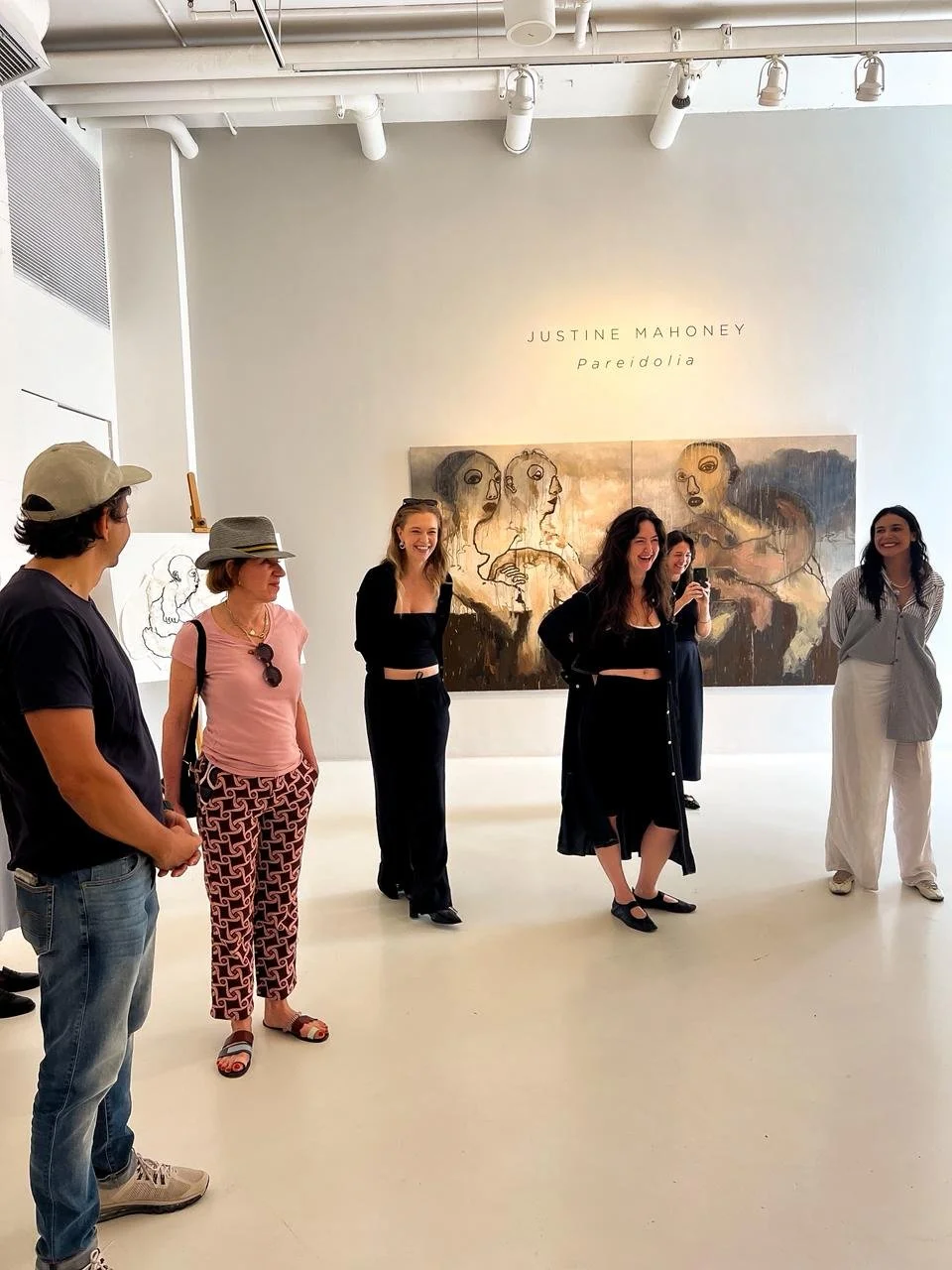
Born in Johannesburg and now based in Cape Town, Mahoney’s practice, Raymond explained, has long been grounded in sculpture. Her early work emerged through ceramic forms, later transitioning into bronze, materials that allowed her to explore weight, texture and presence in deeply physical ways. However, around 2020, there was a notable shift. Mahoney returned to painting, reconnecting with what Raymond described as the origins of her practice, drawing and collage, with painting at its core. This return was not a simple revisiting, but an evolution. Raymond described earlier painting approaches as dense and layered, almost constructed on unconventional surfaces, whereas the current works embrace a more traditional engagement with oil paint. Even within this shift, there remains a sense of experimentation, an openness to process and material that continues to define Mahoney’s work.
Central to the exhibition is the concept of pareidolia itself, a psychological phenomenon where the mind perceives familiar forms, particularly faces, within the unfamiliar. Raymond pointed to how this manifests in everyday experiences, seeing shapes in clouds, or faces emerging through abstract lines and environmental patterns. In Mahoney’s work, this phenomenon becomes a lens through which viewers are invited to navigate ambiguity, to search for recognition within abstraction. Beyond the conceptual, She emphasized the emotional intensity embedded in the exhibition. She spoke of Mahoney’s willingness to engage with deeply personal terrain, describing the works as sites of “wrestling”, a negotiation between control and surrender. There is, she suggested, a tension in the process, the artist enters with intention, yet must remain open to the unexpected, to moments where the unfamiliar surfaces and demands a response.
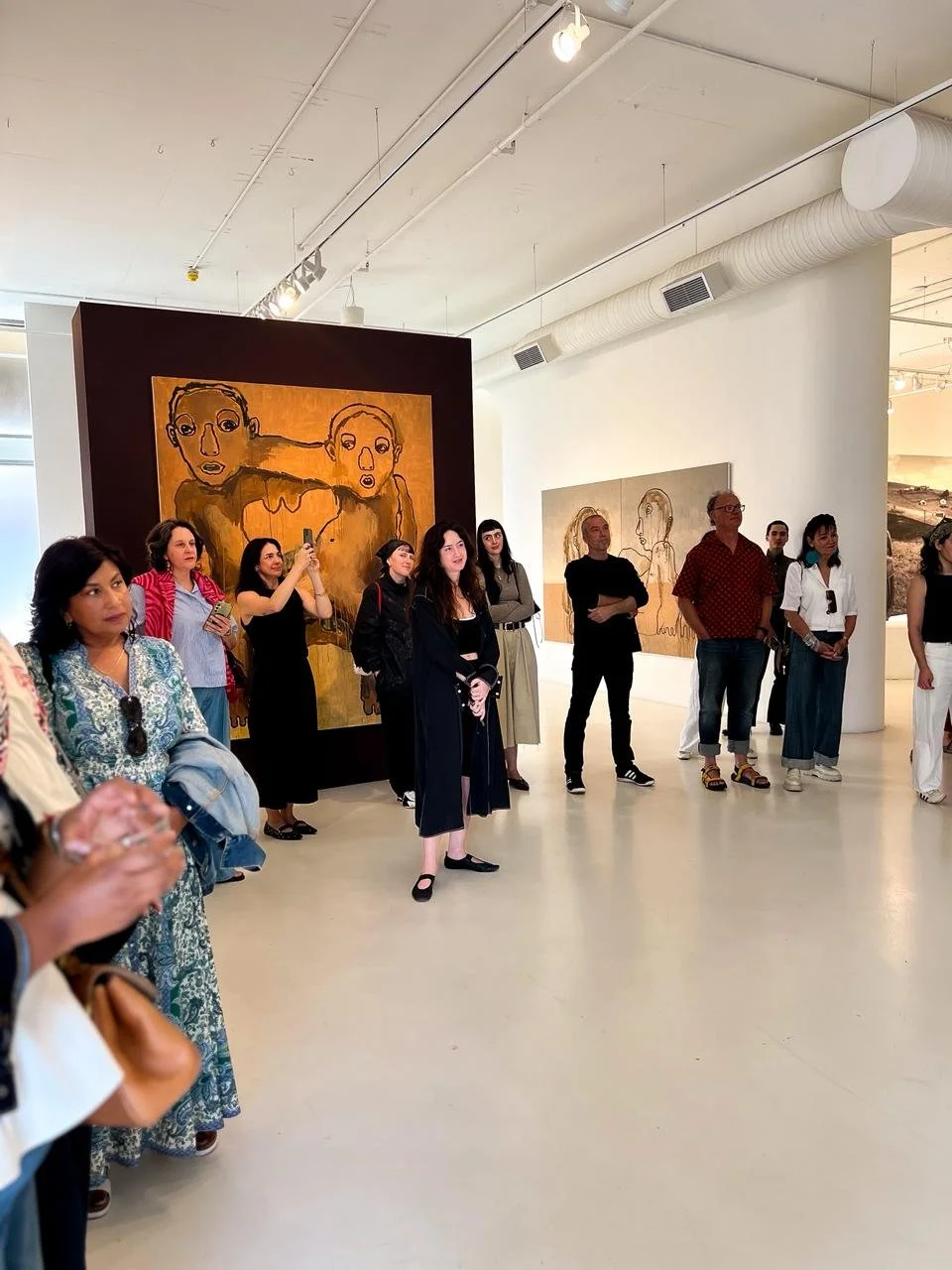
It is precisely this balance, between discipline and experimentation, between the known and the unknown, that she identified as a defining strength of Mahoney’s practice. She highlighted the artist’s courage and distinct visual language, noting that her work resists easy comparison or categorisation. Instead, it stands firmly as its own, shaped through years of exploration and risk-taking. She acknowledged Mahoney directly, commending her bravery and the emotional depth of the work, before inviting her to lead the audience through the exhibition and open the floor for questions.
Following the opening remarks Justine Mahoney invited the audience deeper into Pareidolia, offering an intimate reflection on the conceptual and material underpinnings of her work, one that moved fluidly between philosophy, ecology and personal process. At the heart of her practice, Mahoney posed a foundational question, what does it mean to be human? Not in isolation, but as a body in relation, to the environment, to others and to forms of life beyond the human. This inquiry led her to look closely at mycelial networks, the vast underground systems through which fungi connect plant life. These networks, she explained, act as conduits of communication and care, allowing plants to share water, nutrients and even electrical signals across species. This idea of interconnectedness began to shape the visual language of the work. Forms emerged that echoed mycelium-thread-like, sprawling and relational becoming a kind of connective tissue across the surface of her paintings. Mahoney described being drawn to structures that grow horizontally, spreading and linking at multiple points, forming systems that are at once fragmented and whole.
Central to this exploration is the idea of multiplicity. The works, often held within a monochromatic palette, speak to the many parts and potentials that exist within us as people. Rather than presenting a singular, fixed identity, they suggest a layered, shifting interiority, aligned with post-human thought, where boundaries are blurred and new ways of being are imagined. Within this framework, Mahoney positions her work as a space for radical imagination, where intersections between gender, race, class, culture and nature are not only acknowledged but actively intertwined. In doing so, she also challenges dominant, patriarchal notions of control over nature. Instead of positioning humanity as separate from or superior to the natural world, her work insists on entanglement on coexistence without hierarchy. It is a quiet but firm renunciation of domination and an invitation to think differently about our place within a larger ecosystem of life.
Mahoney also spoke of her long-standing fascination with creation myths, stories in which elemental forces come together to form worlds. She sees Pareidolia as a kind of speculative mythology, a process of world-building where new narratives of existence can take shape. Binding this imagined world together is what she described as a thread of eros, drawn from Jungian thought as the feminine, relational principle that moves through all things. Eros in this sense, becomes a force of connection, capable of holding tension between opposites, dissolving boundaries between self and other and preventing a kind of emotional or spiritual disconnection from the world. This principle, she suggested, is not external, but something that lives within all of us. The work, then, becomes an offering toward that relational force, a call to re-engage with it as a way forward for humanity.
Turning to her process, Mahoney described how these ideas take form materially. She begins with rough, intuitive drawings on paper, allowing shapes and lines to emerge freely. From there, the process becomes physical and responsive, tearing the paper, extending forms and reassembling fragments in search of connection. The act of breaking and rejoining mirrors the conceptual framework of the work, disconnection and reconnection, fragmentation and cohesion. Masking tape, used to bind the torn pieces back together, becomes more than a functional tool. In Mahoney’s words, it takes on a life of its own, like an additional layer of skin, holding the composition together while remaining visible, a trace of the process embedded within the final work. Continuing the walkabout, Justine Mahoney guided us through specific works in Pareidolia, opening up her process in a way that felt both vulnerable and precise, moving between intuition, memory and material. She first drew attention to a quieter detail within the room, a study placed alongside a completed painting. The relationship between the two revealed a delicate translation from what she described as a “chantal study” into a fully realised canvas. It was a moment that made process visible, showing how an idea shifts, expands and settles into form.
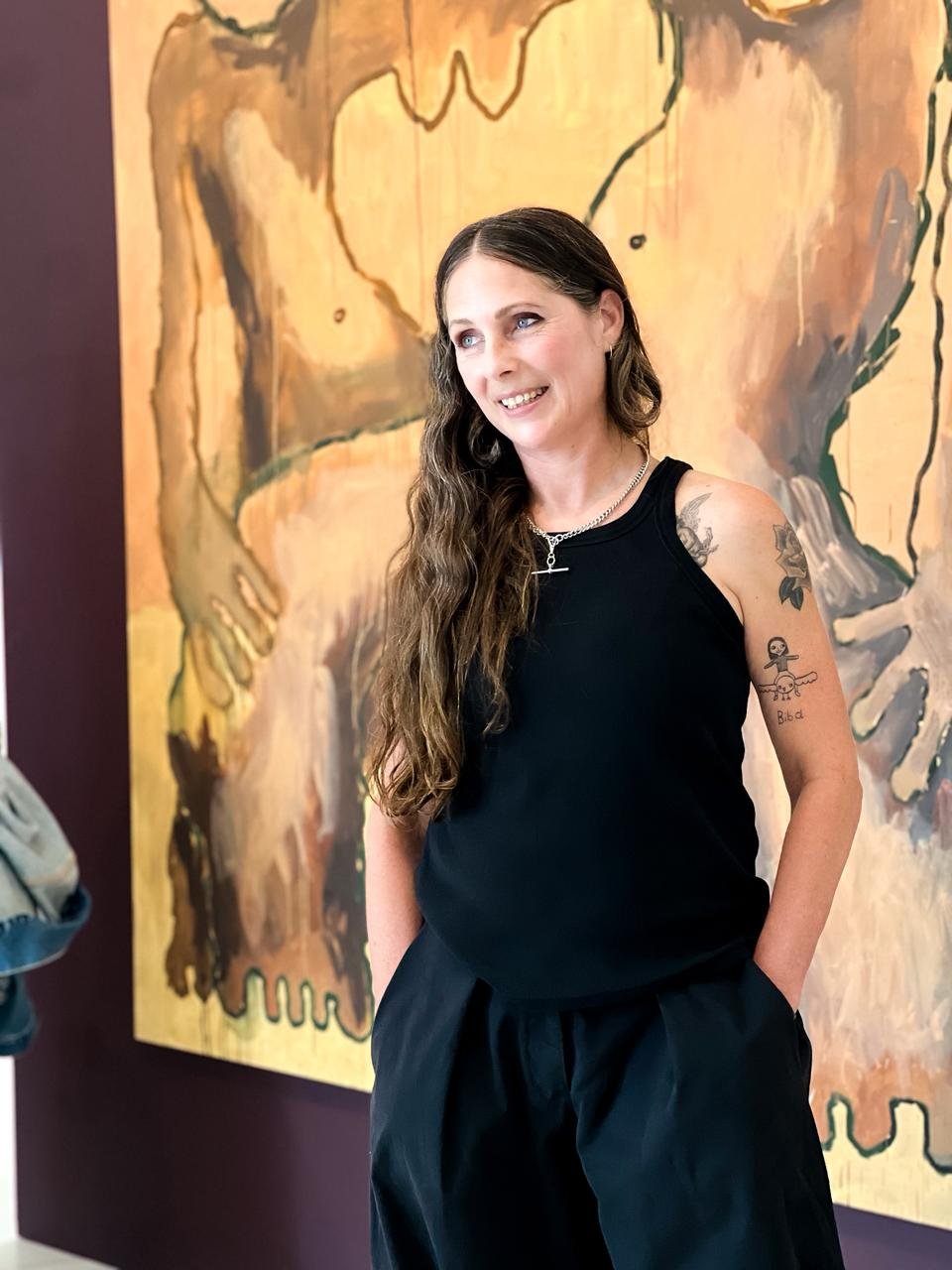
Mahoney then paused at what she described as the very first painting in the series. Unlike the others, it carried a noticeably darker palette, dense, heavy and almost subterranean in feeling. She reflected on how, at that stage, she was still immersed in an earlier phase of her practice, delving into shadow aspects, into what she called “underworld material.” The painting, she suggested, emerged from that psychological terrain. As the body of work progressed, the palette began to lighten, mirroring a kind of internal integration, a movement from depth toward clarity. Her process, she explained, is far from linear or purely rational. Instead, it requires entering an active, almost altered state, one shaped by dreams, memory and sensation. She described writing down dreams, revisiting fragments of her past and even listening to music from her teenage years as a way of accessing that space. It is from here, from this porous boundary between waking and dreaming, that the work begins to surface.
Speaking about the final painting in the exhibition, one she described as a personal favourite, Mahoney noted that it allowed her to “see a way forward.” There was a sense of resolution in it, not as an endpoint, but as a threshold into a new phase of making. This painting, created last, carried a different energy, more open, more assured. The exhibition itself was carefully distilled into 19 canvases, each selected for its strength and contribution to the whole. Yet, despite this sense of cohesion, Mahoney resisted the idea of a fixed narrative or “bookends.” For her, each work must stand independently, even as it participates in a broader conversation.
A significant part of that conversation is her relationship to fear. When asked about it, particularly in relation to working with oil paint, a medium often seen as intimidating, Mahoney spoke candidly. Fear, she said, fuels her. It is something she moves toward rather than away from. The act of approaching a large canvas without certainty, without knowing whether it will succeed, becomes part of the work itself. That vulnerability, that not-knowing, is embedded in the surface of the painting. This tension is visible in works where figures seem to emerge and dissolve simultaneously. In one piece, she acknowledged the presence of what could be read as two figures or perhaps a self and a shadow self, engaged in an exchange. The ambiguity is intentional, Rather than defining her figures too specifically, Mahoney allows them to remain archetypal, open. This openness invites projection, allowing viewers to bring their own inner worlds into the work, much like seeing forms in clouds, a direct echo of pareidolia itself.
As the discussion unfolded, attention turned to the evolution of her mark-making. Earlier works in the series feel dense, filled, almost searching. Later pieces, by contrast, hold more space, light, air and a sense of restraint. This shift, Mahoney acknowledged, reflects a growing confidence. With each canvas, she felt herself becoming looser, more assured, more decisive in her gestures. There is strength in that restraint, a willingness to leave space, to trust what is already present. The final works carry this quiet confidence, not just in technique, but in presence. They speak of durability, of nourishment, of care qualities that resonate with the broader themes of the exhibition. What emerges through Mahoney’s reflections is a practice grounded in movement, between shadow and light, control and surrender, self and other. It is a continuous negotiation, one that resists resolution in favour of openness and in that openness, the work finds its power.
