
On Wings and the Permission to Begin Again: A Zoë Modiga Reflection
By Mpho Molefe
The evening unfolded at The Vault on Bree, a place that by daylight operates as a store, a corridor of carefully folded garments and quiet transactions. But on this night, the commerce had been set aside. The racks stood a bit emptied, repurposed as silent witnesses, and the floor had been softened with an archipelago of woven mats and oversized pillows where most of us found our place. A handful of chairs lingered near the periphery, their metal frames catching the low light, but the body of the gathering had chosen the ground. There is a particular vulnerability in sitting on the floor. It binds the hierarchies we carry in our spines. It makes us listeners before a single note has sounded.
Against one wall, a small bubble machine breathed its slow offerings into the air. Translucent orbs rose in lazy suspensions, each one a brief planet of refracted light, drifting past the racks and the bowed heads of the gathering, disappearing against the ceiling or settling in the folds of a sleeve. They were not announced. They simply appeared, a quiet exhale repeated through the evening, in their unhurried ascent, they became the room’s steady pulse.
We were still settling, the voices low and expectant, when the door opened, and Zoë Modiga walked in.
She arrived not as someone already present, already arranged, but as a figure entering from the outside, and the room tilted toward her as she crossed the threshold. She wore heels that struck the concrete with deliberate clarity, each step a punctuation mark. Bangles lined her arms, a soft chime of metal against metal, and from her shoulders rose a pair of wings. They were delicate, sculptural things, neither costume nor mere ornament but something in between: an extension of her, a declaration that she had chosen to arrive differently tonight. The wings caught the amber light, turning her as she moved through the gathering, and the bubbles drifting past seemed to adjust their course around her, as though the air itself had learned a new choreography.

Image courtesy of Lindeka Qampi
She did not walk directly to her place. Instead, she wound through the bodies on the floor, leaning down to touch a hand here, to exchange a few words with a familiar face there. There was an intimacy to this passage, a refusal of the usual separation between performer and witness. By the time she settled among her collaborators, the room had been reoriented. We had come expecting to receive music, but already we had received something else: the quiet lesson that presence itself is a form of offering.
The bubble machine continued its work. I found myself watching a single orb drift past the edge of one wing, catching light, holding the room in miniature on its surface before it vanished against the dark of a window. It struck me that the bubbles were not mere atmosphere. They were the evening’s quiet metaphor. Art, like a bubble, is a thing of impossible fragility and impossible precision. It requires the correct mixture of breath and intention to take shape, to hold itself together against the pull of dissolution. It rises, it catches the light, it contains a world within its surface for a moment that is both brief and infinite. And then it releases. That release is not a failure. It is the natural arc of anything made with care.
The music began not with a fanfare but with a slow emergence, as though it had been there all along and we were only now learning to hear it. Layered harmonies rose from the speakers, weaving themselves around the floating bubbles. There were passages where the instrumentation fell away entirely, leaving only the grain of Modiga’s voice suspended in silence, and in those moments, the room held its breath together. The songs breathed. They allowed space. They did not rush toward resolution but moved with the patience of something that has learned to trust its own unfolding.
To sit with this music, on the floor of a transformed store, was to feel the weight of what it takes to arrive at such a place. Modiga has long been celebrated for her vocal precision and her refusal to be contained by genre, but this work carried a new quality: the quiet evidence of having moved through uncertainty. There were songs that seemed to address the exhaustion of proving oneself, the years of showing up when the path was unclear. There were others that built into defiance and joy, as if to say that healing does not mean forgetting what hurt but continuing to create in spite of it. For anyone in that room who had ever found themselves at a crossroads, in art or in life, the message was gentle but unmistakable. The detour is not the end. The pause is not a failure. The willingness to keep showing up, to trust the craft even when it does not reward you quickly, is itself a form of devotion.
Then came a moment between songs when Modiga set down the handheld microphone she had been using to speak, her bangles chiming softly with the movement. The room, already quiet, grew quieter still. She spoke not as a performer addressing an audience but as someone sharing a piece of news with old friends. She mentioned, almost in passing, that she had once been a student at the South African College of Music, that she had loved it, that she had poured herself into it, and that she had eventually had to drop out.

Image courtesy of Lindeka Qampi
She did not dwell on the reasons. She did not turn the admission into a story with a moral. She simply let it sit there in the air, among the drifting bubbles, a small truth released.
That moment lingered with me long after the evening ended, not because it was dramatic but because it was familiar. I recognised something in the way she said it: the particular weight of leaving something you had once believed would carry you forward, the quiet recalibration that follows, the slow work of rebuilding trust in your own path. I have carried a version of that weight myself, and to hear her name it so plainly, in a room full of strangers who had all come to witness her artistry, felt like a door opening. Not into her story, but into a shared understanding that the roads we travel are rarely the ones we first imagined.
It is easy to look at an artist standing in heels and wings, surrounded by music she has shaped from silence, and imagine that her journey has been a straight line, a matter of talent meeting opportunity. But the truth is more human, and more hopeful. The truth is that she sat in classrooms once, as many of us have, and she faced a door that closed, and she had to decide whether to keep making work without the validation she had once sought. That she is here now, in this transformed store, offering songs that breathe and ache and celebrate, is not evidence of a life without interruption. It is evidence of what happens when an artist refuses to let interruption become the end of the story.
In that moment, I understood more clearly what I believe about art as a healing force. Healing does not come from perfection. It does not come from work that pretends to have transcended difficulty. It comes from connection. It comes when an artist steps forward and says, plainly, I have known what it is to stumble, and the person listening says, without words, I have too. There is a restoration in that exchange that no amount of technical brilliance can replicate. It is the restoration of knowing you are not alone in the detours, the setbacks, the quiet seasons of doubt. It is the restoration of seeing someone rise after a fall and recognising that your own rising is still possible.
Modiga offered that restoration without fanfare. She did not make the evening about her struggles. She made it about the work that has grown from them. And in doing so, she demonstrated something I have come to hold as true: that the artists who move us most deeply are not necessarily the ones who have suffered the most, but the ones who trust us enough to let us see that they have suffered at all. There is courage in that trust. There is a form of generosity that looks like vulnerability but is actually something else: it is the offering of a shared humanity, held out like a hand in a room full of people who came to listen.
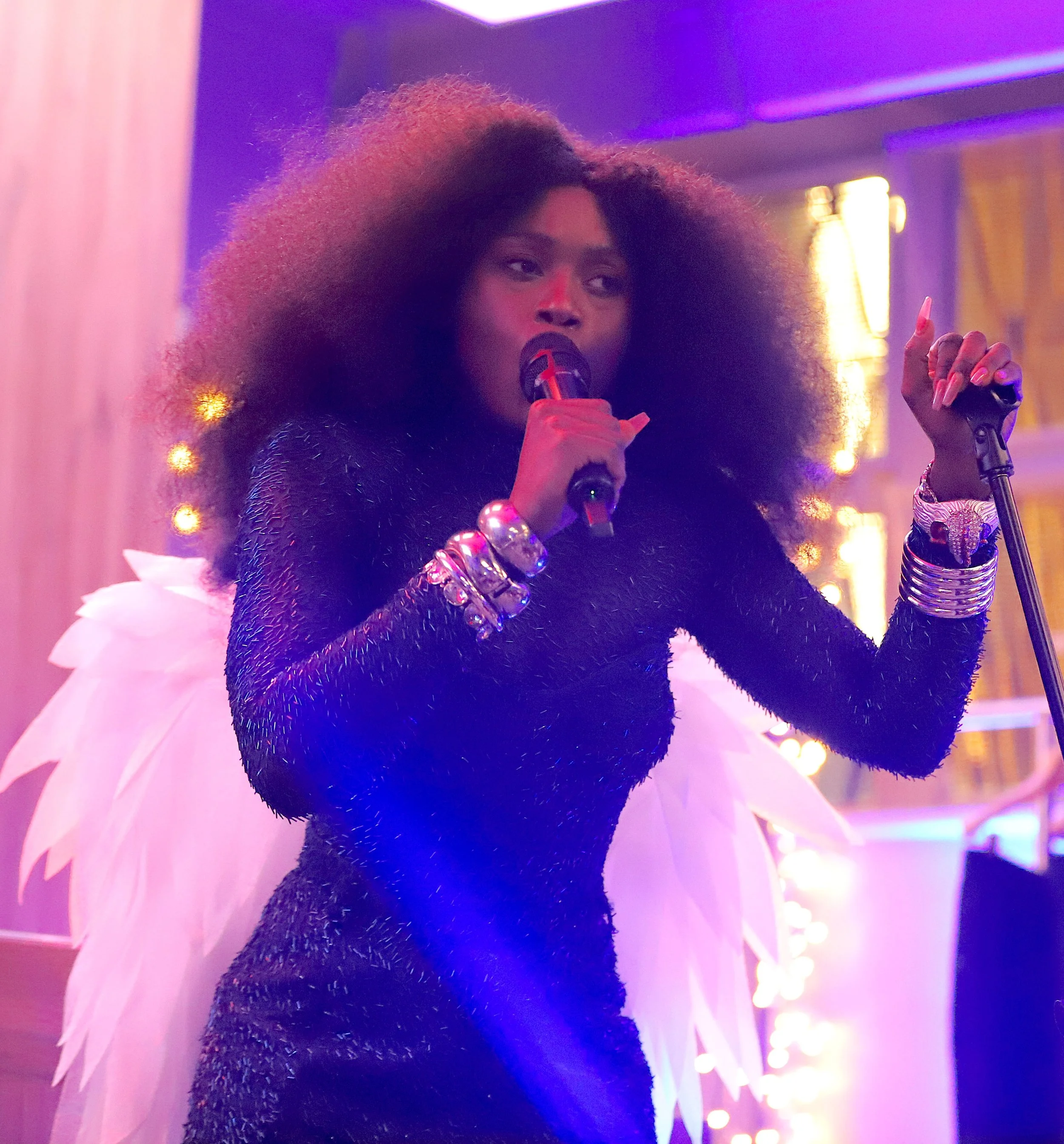
Image courtesy of Lindeka Qampi
The bubbles kept rising. Some floated high, catching the light for a long while before dissolving against the rafters. Others burst immediately against a raised hand or the tip of a wing. There was no controlling them, no dictating how long they would last. That too became part of the evening’s teaching. Art is made of intention but also of surrender. You shape it as best you can, you offer it to the air, and then you let it go. What happens next, how far it travels, whose attention it catches, how long it holds: these are not yours to decide. Your work is in the making. The rest is trust.
By the time the final track faded, a piece that felt less like a conclusion than a door left ajar, the room did not erupt in applause. It exhaled. People lingered on the floor, letting the silence settle around them. Modiga sat among her collaborators, her wings now resting, her face carrying the particular peace that comes after an offering has been received. She had arrived in heels and wings, in bangles and a new kind of boldness, and she had given us music that asked nothing more than to be heard. In return, the room had given her its full attention, not the distracted attention of obligation but the deep attention of people who understand that art, in its truest form, is a mutual act.
Walking out into the Cape Town night, past the emptied racks of The Vault and into the Bree Street murmur, what lingered was not a single lyric but a feeling. The quiet assurance that creation is worth the effort, that setbacks are not endings, that the work of making, whether music or meaning, is sustained by patience, by trust, by the willingness to keep showing up even when the path winds unexpectedly. The bubbles had done what they were meant to do. They had risen. They had caught the light. They had shown that beauty does not require permanence to be real. And somewhere in that understanding, for the artist and for everyone who sat on the floor of that store, there was healing. Not the loud kind, the kind that announces itself with declarations. The quieter kind. The kind that arrives when you stop trying to force the shape of things and allow yourself, for a moment, simply to rise.
