
“Keep Believing”: How Lian Ndappe Found Joy, Visibility and a Global Queer Family at the Gay Games
By Mpho Molefe
The first thing Lian Ndappe wants you to know is that she is here. Not simply present, but fully, unapologetically here - on the pitch, in the parade, and in a life she has built with dignity and joy. And she wants that same truth to echo far beyond these stadiums, into every country where it still feels impossible to simply be.
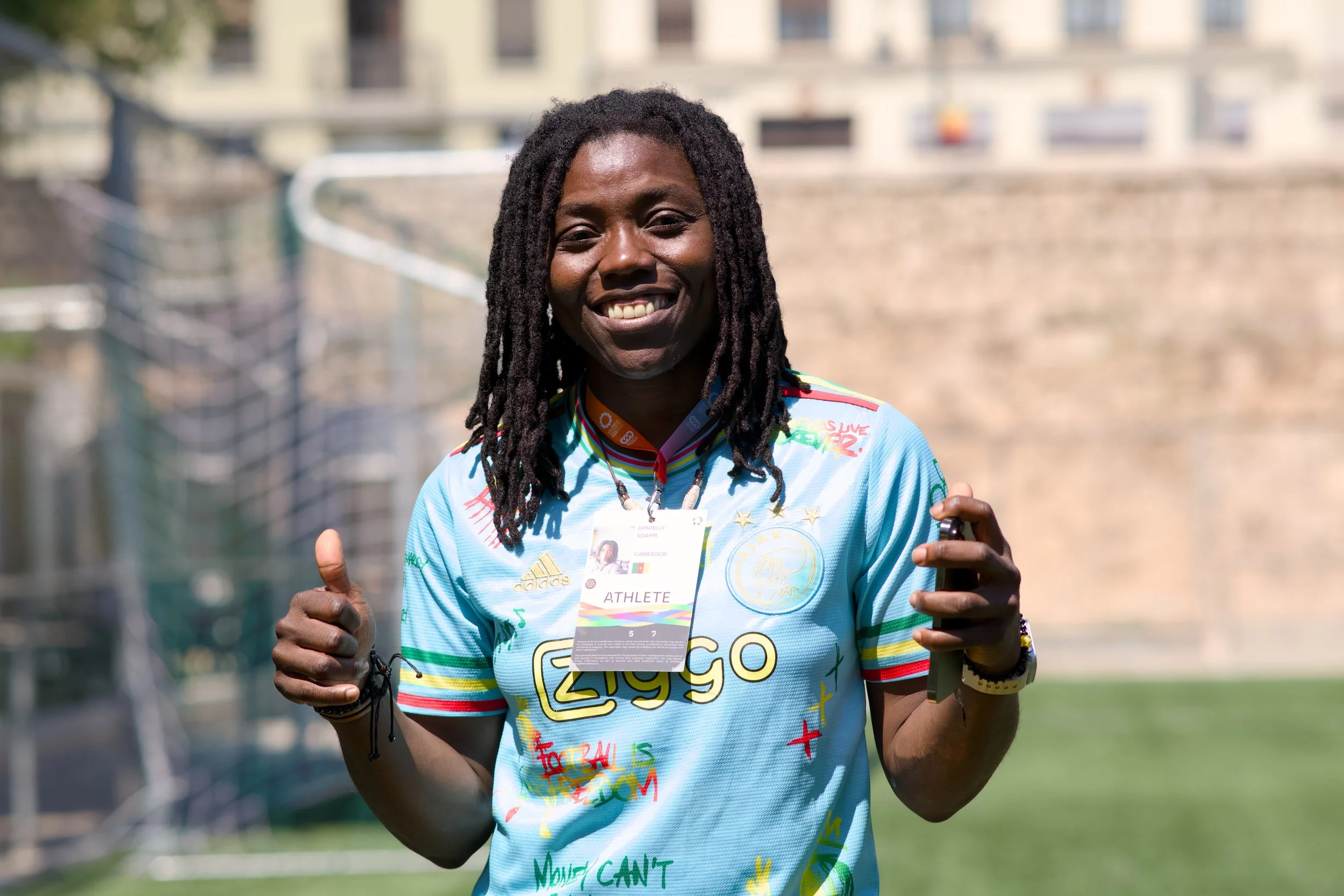
Lian Ndappe at Campo de fútbol Puente de Madera during Gay Games XII València 2026. Originally from Cameroon and currently studying medicine in France, Ndappe joined the Games as an opportunity to participate in a global queer community and to affirm that LGBTQ+ people everywhere deserve to live, study, love, and thrive with dignity. | Photo by Xolani Sithole
It’s a sun-drenched afternoon at the Gay Games, and the football tournament is in full swing at Campo de fútbol Puente de Madera. Among the clusters of athletes swapping jerseys and stories, a tall, quietly radiant player stands out. Her name is Lian Ndappe. She is Cameroonian, a medical student currently living in France, and as she will tell you without hesitation, a proud lesbian. She’s also someone who almost missed this entirely, until a single invitation on social media changed everything.
“I came across a post inviting queer people to participate in the Gay Games,” Lian explains. “I had never heard of the Gay Games before, and for me, it was an opportunity to finally be part of a large, meaningful queer community project.” That sentence, simple as it is, holds the why of her journey: a hunger not just to compete, but to belong to something bigger than herself. Something that could push back against the silence and isolation so many LGBTQ+ people know too well.
Who She Is - and What She’s Carrying
To understand what Lian brings to these Games, you have to understand the years she spent kicking a ball long before she ever heard the word “lesbian” used as a source of pride. Who Lian is on the field started taking shape when she was a child in Cameroon, a self-described “tomboy” who ran with the boys and never once questioned whether the pitch was her place.
“I think I was very fortunate. I’ve always been what people call a tomboy, and I played with boys from a very young age. I never felt like I didn’t belong on the pitch,” she recalls. The early years were pure — football was simply hers. The trouble came later, with the adults. “It was only as I got older that adults’ attitudes and judgments made me wonder whether I really had the right to play football the way boys did.”
That fracture between a child’s natural sense of entitlement to joy and an adult world’s eagerness to draw borders around gender and desire could have driven her from the game. But Lian was shielded by something increasingly rare and immeasurably powerful: parents who refused to let outside voices drown out their daughter’s truth. “Thanks to the love and support of my parents, I was able to believe in myself again and keep playing this sport,” she says. That family love is the invisible backbone of her story, and she carries it into every match. She plays, she says, simply because she loves it. But she has also transformed that love into a declaration for others: “You have the right to do what you love. No one has the right to tell you that it isn’t meant for you or that you don’t belong.”
What She Found: A Feeling Bigger Than Football
The Gay Games are often described as a sporting event, but those who’ve lived them know they are something else entirely: a temporary nation where the currency is visibility, and the anthem is the sound of thousands of people exhaling together. For Lian, the what of these Games is captured not in the scorelines, but in an emotional shift from hiding to being seen.
“I definitely feel more visible here,” she says. “I feel seen and valued. People encourage me, compliment me, and celebrate me, and that’s something that is often missing elsewhere.” That shift defines her experience. In a world that still spends too much energy telling queer people to dim their light, the Gay Games have turned up the wattage. Lian’s voice warms as she explains why that matters: “That’s why we came: to share this happiness.”
She doesn’t stop at describing her own feelings. She turns them into a vision. “I wish the world could always feel this way. We are here to show people what it looks like when we are happy together. And I hope that, in the near future, people everywhere will be able to play, participate, and celebrate alongside one another in joy and freedom.” That’s the what at its core: a living, breathing blueprint for a world that doesn’t yet exist for everyone, but that she believes can be built.
The Where and When That Changed Everything
If Lian had to point to a single where and when that crystallised everything the Gay Games represent, it wouldn’t be the football pitch. It would be the opening parade of nations, a cascade of flags, families and fierce tenderness. She speaks of it with the kind of reverence usually reserved for sacred spaces.
“The most memorable moment for me was the opening parade of nations on the very first day. Seeing people from all over the world gathered together was incredibly moving,” she says. The detail she offers next reveals just how deeply she registered the cost (and the love) behind every smiling face. “So many made great sacrifices to be here. They travelled long distances, brought their children and partners, and came with their families. Some stepped away from work, others paused their studies, all to be part of this experience.”
For Lian, a student who has navigated migration, medicine, and the ongoing work of claiming her identity, that parade was proof that the community she had glimpsed through a phone screen was real, and that its roots ran deep. “It really showed me how important it is to be here and to uplift the LGBT community,” she says. “That’s why the first day remains the most memorable moment for me.”
How She Carries This Forward, and the Soundtrack of the Struggle
Ask Lian about a soundtrack for these Games, and she offers a dual answer that reveals both her personal loves and her political consciousness. “The first song that comes to mind is Purple Rain by Prince, simply because Prince is my favourite artist,” she says with a smile. The song, with its aching beauty and promise of transformation, suits someone who believes that pain can be followed by a cleansing, liberating storm. But then she pivots, insisting that the real soundtrack isn’t a single track at all: “When I think about the soundtrack of this tournament itself, I keep thinking about yesterday and the parade.” That’s the how, not a melody that can be captured and reproduced, but the lived sound of thousands of feet marching, voices shouting in different languages, a symphony of belonging that must be experienced to be understood.
It’s in this same expansive spirit that Lian shapes her message for LGBTQ+ people still living under repression, those who dream of one day walking in that same parade. Her words are a bridge between those who came before and those still waiting to arrive. “Remember that many people before us fought and sacrificed so that these spaces could exist,” she says, her voice carrying the weight of history. “Keep believing. We are here continuing that struggle so that one day you can be here as well — sharing these moments with us, wherever you are in the world.”
This is the how of survival and resistance: not grand gestures alone, but the daily act of holding onto hope, of finishing a degree, of showing up to training, of refusing to edit yourself. Lian Ndappe, medical student, footballer, lesbian, and now Gay Games athlete, is doing all of that. And she is doing it in the full light of day, inviting the rest of the world to watch, and to follow.
Lian Ndappe competed at the Gay Games as part of the football tournament, representing not just a team, but a belief that joy is never frivolous; it is foundational. She continues her medical studies in France, still plays whenever the pitch calls, and hopes that every LGBTQ+ person living under repression hears this: the parade is already marching, and a place is being held for you. This is the first in our Athlete Spotlight series, telling the stories behind the medals, the marches, and the music. Follow along as we meet the people who are already building the freer world they want to live in.
