
MAI AiR Cape Town 2026: Thirteen Days at the Heart of Things
By Lufuno Ramadwa
There are some gatherings that are simply about showing up. And then there are gatherings where something quietly shifts - where a group of strangers becomes a collective, where a city stops being a backdrop and becomes part of the work itself. The MAI AiR Cape Town residency in February 2026 was the second kind.
For thirteen days, seventeen artists, makers, thinkers, and storytellers from South Africa, the United States, Panama, and Europe came together in Cape Town. We were photographers and filmmakers, textile artists and performers, curators and educators. Some of us had travelled from Los Angeles and London. Others had come from King William's Town and rural Eastern Cape communities, for whom the trip to Cape Town was a first. We arrived with different practices, different histories, different reasons for being there. But somewhere along the way, something clicked.
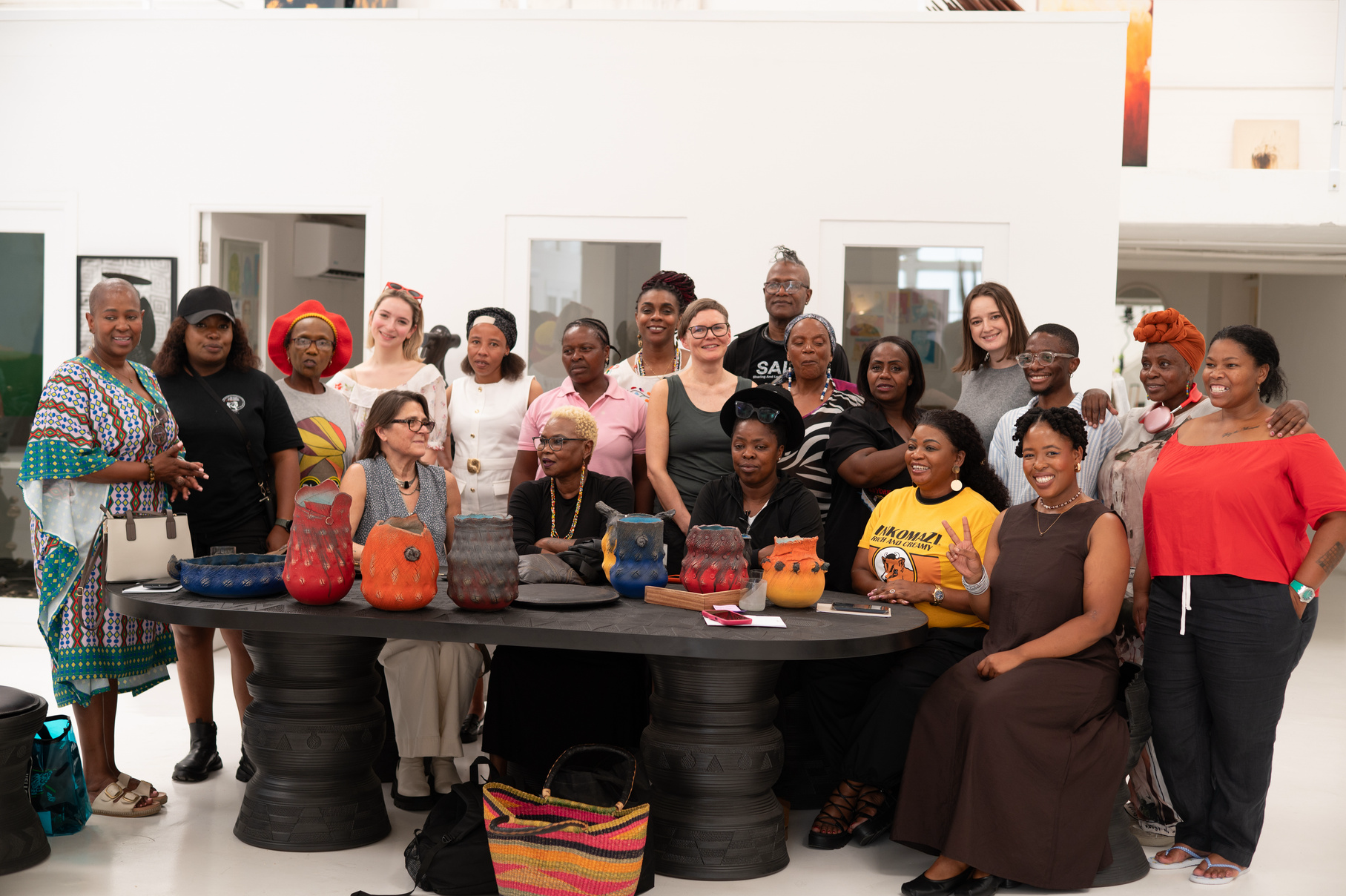
Seventeen artists from the MAI AiR Cape Town residency pose together outside Southern Guild Gallery in Cape Town. The group reflects a mix of generations, races, and creative disciplines.
The City as Companion
Cape Town has a way of getting under your skin. It is beautiful and complicated, generous and difficult, and it does not let you remain a spectator. From the moment we landed, the city was not just where we stayed — it was what we worked with.
We began at Southern Guild, the gallery that represents Zanele Muholi’s work, walking through the space with the team, asking questions, feeling the weight of what it means to have your practice held by an institution. Later, we found ourselves at Thebe Magugu House at the Mount Nelson, touring the space with Xola Makoba, then winding our way to the Norval Foundation in Tokai for an exclusive walk-through of Portia Zvavahera’s exhibition Tanda rima. That evening, we sat together around a long table at an Ethiopian restaurant in the city, passing dishes and trading stories. It felt less like a programme and more like a slowly forming family.
There was a photoshoot at Vredehoek Dam with the Southern Guild artists (Zanele among them) led by siblings Haneem and Imraan Christian. We stood in a dramatic below-ground location as the light shifted, and by the time we emerged, the sun was setting over the mountain. It was one of those Cape Town moments that makes you forget you're working.
The Bavulele Installation: Women at Work
The heart of the residency lived in a space outside the main ticket desk at the Cape Town International Convention Centre. For two days during the Investec Cape Town Art Fair, the Bavulele collective took over that corner of the building, and something extraordinary happened.
Women who spend most of their lives in the Eastern Cape, women who crochet as a practice of survival and care, sat in the middle of one of Africa's most prestigious art events and simply did what they do. They crocheted. They talked. They laughed. And when Phumla Qampi began to sing while her hands kept moving, the space became something else entirely — a living artwork, a quiet revolution happening in plain sight.
There was a scan-to-code system on small stands nearby, a simple innovation that let visitors access artist bios and stories. People from the United States and Europe scanned it, engaging with the work long after they'd left the building. But the real magic was in the room: the way visitors stopped, really stopped, to watch women work. The way Charmain Carrol, the collective's lead, explained their practice with a clarity and warmth that made strangers want to stay. The way Lulu Molinares from Panama sat down with the group and started crocheting alongside them, unprompted, simply because it felt natural.
And then the learners arrived.
The Learners Who Sang
Seven young people from Phakhathi High School in Durban — Wandile, Nkosikhona, Mfundo, Ayanda, Nontobeko, Sipho, and Aphelele — travelled to Cape Town with their teacher, Mrs Nsindane. For most of them, it was their first time in the city. It was certainly their first time at an art fair.
They moved through the space with the kind of wide-eyed attention that reminds you why this work matters. They watched the Bavulele ladies. They took in Zanele's workshop. And then, in a moment no one had planned, they simply began to sing.
It was spontaneous. It was joyful. It was seven young people from KwaZulu-Natal, moved by what they were experiencing, responding in the most natural way they knew. The Bavulele ladies joined in. Strangers stopped to watch. And for a few minutes, the art fair was not about commerce or curation — it was about connection.
That moment will stay with me. It is exactly what residencies are for.
A Workshop on Looking Inward
On the Saturday of Art Fair week, Zanele Muholi facilitated a workshop inside the convention centre. The title was Looking Inward—A Self-Portrait Workshop, and it drew a room full of people: art fair visitors, students, established practitioners, and those who had never done anything like it before.
The theme of this year's fair was Listen, and Zanele's workshop embodied it. Cameras were provided, so equipment was no barrier. The instruction was simple: turn the lens on yourself. Sit with what that reveals. Understand that photographing yourself is not vanity — it is visibility. It is insisting that you exist.
Phumla performed before the workshop began, her voice filling the space and settling something in the room. Then Zanele guided a room full of strangers through the act of looking inward. It was generous and rigorous, and it was exactly the kind of thing that belongs at an art fair but so rarely happens.
The People Who Made It a Collective
Residencies are ultimately about people. And this group was special.
Karla Funderburk arrived from Los Angeles with a calm, grounded energy that made everyone around her feel seen. She connected with Lindeka Qampi and Charmain Carrol in a way that has already begun to bear fruit—the three are now talking about a collaborative exhibition in Los Angeles. That is the kind of outcome you cannot plan for.
Yrneh Gabon brought intellectual depth and practical generosity in equal measure. At the installation, they were everywhere — connecting visitors to the work, explaining the collective's practice, using their network to generate interest. Since returning to the US, they have stayed in conversation with the Bavulele ladies about future collaboration.
Courtney Desire Morris arrived and was immediately adaptable. Her first engagement was not an orientation but a drive to Worcester for a funeral—an intimate introduction to South African community life. She went without hesitation. Later, a beach photoshoot with Zanele and Lindeka became one of the residency's most beautiful creative moments.
Lulu Molinares stepped off a plane from Panama into the full intensity of Art Fair week and simply joined. At the installation, they sat with the crochet group and worked alongside them, producing pieces in real time. Their ethos (instil care through practice) was visible in everything they did. The interview Wakhe filmed with them became the residency's most-viewed post, and it is easy to see why.
Constanza de Medici documented the entire residency on her phone with the same intentionality others brought to professional cameras. She visited Robben Island independently, pushing her engagement with Cape Town beyond the programme. She was a quiet, consistent presence — the kind of participant who makes a programme better simply by being fully there.
Nobuzwe Mabona arrived from the Eastern Cape with a garment she had made: a flowing blue piece that Zanele wore to the workshop. It was a designer's quiet statement about what clothing can do in a public-facing context. Beyond the garment, Nobuzwe showed us AI-generated design mockups that revealed someone thinking deeply about the future of craft.
Lindeka Qampi was the residency's documentary backbone — always present with a camera and an archivist's commitment. But she was also its guide, leading a tour of Langa after her Bush Radio interview, ensuring international visitors left with an experience of Cape Town beyond the art world. The beach photoshoot she did with Courtney and Zanele was a moment of genuine creative healing.
Wakhe Sebenza arrived with an iPhone, a tripod, and a laptop—and produced some of the most compelling content of the programme. His interviews with the Bavulele ladies had real depth because he created conditions in which people felt comfortable speaking honestly. The newsletter he produced during the residency was beautiful; it should become a monthly thing.
Mpho Molefe built the scan-to-code system that extended the installation's reach across oceans. They managed the residency's digital presence in real time, turning documentation into content that kept the programme visible while it was happening. Their creative partnership with Wakhe seemed almost telepathic.
And then there were the Bavulele women themselves.
Charmain Carrol became the installation's public face—explaining the collective's work to strangers with clarity and warmth. Visitors stopped because she gave them a reason to.
Nomonde Mfunda brought a quiet expertise that formed the technical foundation of everything on display.
Thuliswa Tati arrived knowing nothing about crochet and left able to make jerseys, hats, and ribbons. Her transformation was visible.
Mandisa Sokoko encountered Cape Town, the Art Fair, and public art-making for the first time — and took it all in stride.
Lulama Soldaka, mother of five and self-described hustler, spoke openly about her gay son at university. In a programme shaped by Zanele's visual activism, that openness mattered.
Buyiswa Mary-Jane Nyubuse, 66 years old and retired, sat in the middle of Cape Town Art Fair and crocheted. That image alone is worth everything.
Phumla Qampi sang while she worked, filling the space with something that cannot be scheduled or designed.
Lusanda Dayimani danced in the Langa museum and lifted the room. Her energy is the kind you want more of.
And Mrs Nsindane brought seven young people from Durban and held them with the kind of calm authority that only comes from years of caring.
What We Carry Forward
Thirteen days in Cape Town. Seventeen artists. One installation. Countless conversations. A dinner for 40 at Grand Beach Café, the sea in front of us, the city behind us, all of us at ease in a way that only happens when something has gone right.
The relationships built in those days are still producing outcomes. Exhibitions are being planned. Collaborations are being discussed. Friendships are being maintained across continents.
The foundations are laid. The work continues.
